The story of artificial neural networks does not begin in a computer science laboratory. It begins in biology, in the late 19th century. Before we can build artificial brains, we need to see how humanity discovered how the biological brain works.
One network or many cells?
In the 1870s a prominent theory, the Reticular Theory proposed by Joseph von Gerlach, argued that the nervous system was one gigantic, continuous network and not a collection of individual cells. Camillo Golgi, who developed a breakthrough chemical staining technique that let researchers examine nervous tissue under a microscope, supported it.
Using Golgi's exact same technique, Santiago Ramón y Cajal reached the opposite conclusion: the nervous system is a huge network of discrete, individual cells that communicate with one another. This idea became known as the Neuron Doctrine.
In 1891 the term "neuron" was coined, and the scientific community gradually accepted that the brain is a collection of these discrete units. The debate was so fierce that in 1906 the Nobel Prize in Medicine was awarded to both Golgi and Cajal, despite their conflicting theories. It was not fully settled until the 1950s, when the electron microscope let scientists see a tiny physical gap between cells, the synapse.
The biological neuron
The human brain is a massively parallel, interconnected network of roughly 100 billion () neurons. A typical neuron has four main parts:
- Dendrites: tree-like structures that receive input signals from other neurons.
- Soma: the cell body, which combines the incoming information.
- Axon: a long cable that carries the result to other neurons.
- Synapse: the connection point. Its strength determines how much of the signal passes between the two neurons.
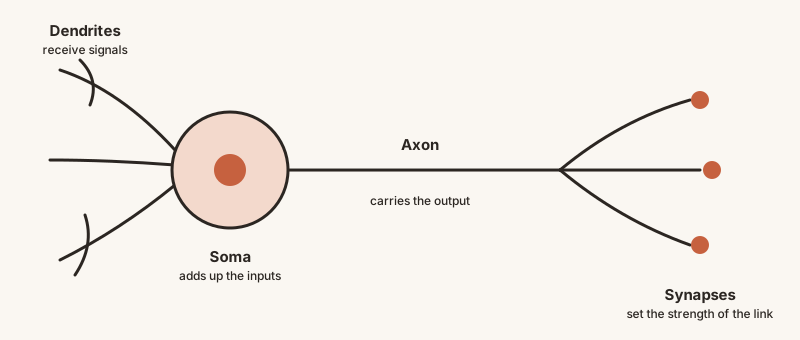
Keep the last part in mind. A synapse with a strength becomes, in later lessons, a weight. Learning in a brain changes synapse strengths, and learning in a neural network changes weights.
Why start here
You can build neural networks without knowing any of this. But it explains the vocabulary (neuron, synapse, activation) and a pattern you will keep meeting: ideas from one field stay useful for decades and get rescued by technology from another. The neuron debate was settled by better microscopes, not by better theories.