1943: a neuron as a logic gate
Warren McCulloch was a neuroscientist and Walter Pitts was a logician. In 1943 they asked whether a network of very simple units could compute anything a logical argument can. Their unit, the McCulloch-Pitts (MP) neuron, is about as simple as a model can be:
- Inputs are on or off (1 or 0).
- The neuron adds them up.
- If the sum reaches a threshold, the neuron fires (outputs 1). Otherwise it stays silent (0).
Choosing the threshold gives different logic gates. With two inputs, a threshold of 2 gives AND (both must be on), and a threshold of 1 gives OR (either is enough).
A decision makes this concrete. Should I go to the cinema? Inputs: is it dry, do I have money, do I have time? Set the threshold to 3 and you go only when all three are true.
1958: the perceptron and learnable weights
The MP neuron has a weakness. Every input counts equally, and a human has to set the threshold by hand. In 1957 and 1958 Frank Rosenblatt added two things:
- Weights. Each input has its own number saying how much it matters. "I have money" can count for much more than "I feel like going out".
- A learning rule. If the neuron gets an example wrong, nudge the weights toward the right answer. Repeat over the examples.
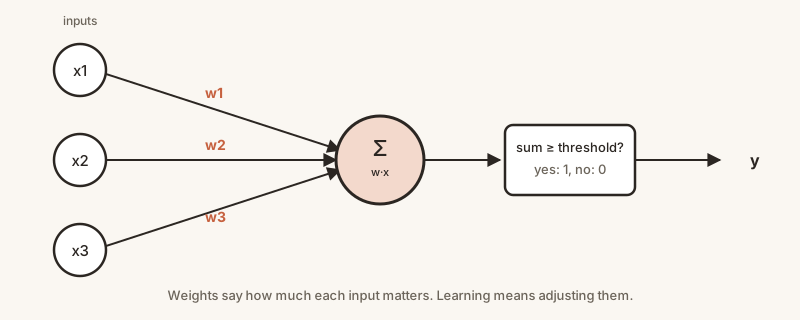
The big idea is that the machine finds its own weights from examples. Nobody has to write the rule. That is still the core of machine learning.
In practice the threshold is folded in as one more learnable number, the bias. You will see "weights and bias" in every modern framework.
Move the threshold and the weights and watch which inputs make the neuron fire.
Watch the weights change after each mistake until every example is classified correctly.
1956 to 1958: the word, and the hype
The term artificial intelligence was coined for a summer workshop at Dartmouth in 1956. Two years later the US Navy showed off Rosenblatt's machine, and The New York Times reported it as the embryo of a computer that would "walk, talk, see, write, reproduce itself and be conscious of its existence".
Rosenblatt himself thought the perceptron might one day learn, make decisions and translate languages. Translation was a high priority after the war, so it was an obvious thing to hope for.
Seven decades later, machine translation has improved enormously, but it is still imperfect for many languages. The hopes were not foolish. They were far too early, and that became a pattern.