Artificial Intelligence is often dressed up in the shiny, dramatic narratives of science fiction movies, but the reality is much more practical and deeply rooted in our everyday lives. At its simplest, AI is just a way to teach computers to find patterns in data and make decisions based on those patterns.
To understand how this works, let’s imagine our mascot, a studious owl. Growing up, our owl faced a quiet but massive roadblock: a severe language barrier in education. The owl had a deep thirst for knowledge, but the best textbooks and resources were written in a language it couldn't easily understand.
Today, that same owl doesn't face that roadblock. When browsing an educational platform, the owl is instantly served personalized course recommendations based on what it studied yesterday. If a complex article is in another language, the owl pastes it into ChatGPT or Gemini, and the software translates it flawlessly in seconds. When the owl takes a break on Instagram, the app knows exactly which funny nature Reels to show next. None of this is magic or science fiction. It is all driven by AI algorithms that have learned the owl’s preferences and understand human language.
But how did we get to a point where a computer can seamlessly translate a textbook or predict exactly what video you want to watch? The journey was actually a dramatic rollercoaster of massive breakthroughs, crushing disappointments, and triumphant comebacks.
History and Evolution of AI
The Perceptron Model
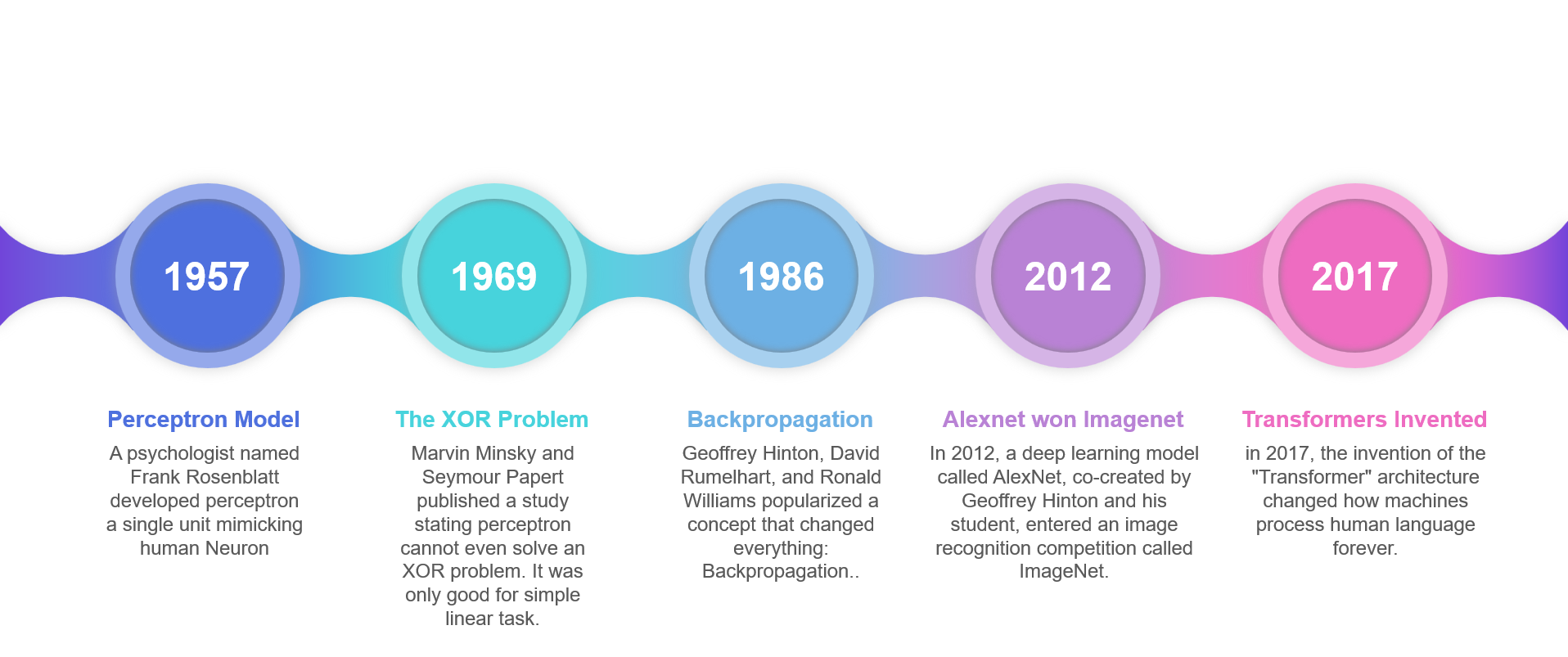
The story truly begins in 1957 with a psychologist named Frank Rosenblatt. He wanted to build a machine that mimicked a single neuron in the human brain, which he called the "Perceptron." Imagine our owl trying to decide whether to go hunting. The perceptron would take a few simple inputs—"Is it dark?" and "Am I hungry?"—assign a weight of importance to each, and output a simple yes or no decision. It was a groundbreaking idea, and people believed human-like machines were just around the corner.
The XOR Problem
That early optimism crashed in 1969. Two prominent researchers, Marvin Minsky and Seymour Papert, published a book proving that the simple perceptron had a fatal flaw. It was too basic. It could only solve problems where the answers could be separated by a perfectly straight line. They proved it couldn't even solve a basic logic puzzle called the "XOR problem" (an exclusive-or scenario). Realizing that these early networks couldn't handle complex, real-world data, governments and investors pulled their funding. The research stalled, plunging the field into what is known as the first "AI Winter".
Backpropagation
For over a decade, neural networks were largely abandoned. But in 1986, researchers including Geoffrey Hinton, David Rumelhart, and Ronald Williams popularized a concept that changed everything: Backpropagation.
If our owl tries to catch a mouse and misses, it learns from that error and adjusts its swoop for the next time. Backpropagation allowed artificial neural networks to do exactly that. By stacking multiple layers of these artificial neurons and passing the "error" backward through the system, the network could mathematically adjust its own weights. The machine was finally learning from its mistakes.
Despite the brilliant math of backpropagation, the 1990s brought another hurdle. Training these multi-layered networks required massive amounts of data and incredible computing power, neither of which existed at the time. Neural networks hit another wall, and a second, milder AI winter set in for deep learning.
However, other branches of AI continued to quietly evolve. Researchers focused on highly specialized tasks rather than general brain-like networks. This culminated in a massive milestone in 1997 when IBM’s Deep Blue supercomputer defeated the reigning world chess champion, Garry Kasparov. It proved that machines could out-calculate human experts in specific, bounded environments.
Deep Learning Explosion
The modern era of AI, the one that powers our world today, truly ignited in 2012. Two things had changed: the internet provided massive oceans of digital data, and researchers realized that the graphics cards (GPUs) used for video games were perfect for the heavy math required by neural networks.
In 2012, a deep learning model called AlexNet, co-created by Geoffrey Hinton and his student, entered an image recognition competition called ImageNet. The challenge was to correctly identify objects in thousands of photos. AlexNet didn't just win; it completely demolished the competition, proving that "Deep Learning"—networks with many hidden layers—could finally "see" and categorize the world better than any traditional software.
Modern era of LLMs
From 2012 onward, the dominoes fell rapidly as deep learning proved its incredible potential. In 2016, AlphaGo by Google DeepMind achieved what experts thought was still decades away: it defeated Lee Sedol, a world champion at the ancient and complex board game of Go. This was a monumental shift because Go cannot be won by simply calculating every possible move; there are more possible board configurations than there are atoms in the observable universe. The game relies heavily on human intuition, and AlphaGo demonstrated that a machine could learn to "feel" out a strategic advantage.
Then, in 2017, the invention of the "Transformer" architecture changed how machines process human language forever. Before Transformers, AI read text sequentially, word-by-word, often losing the overarching meaning of a long paragraph. The Transformer allowed machines to process massive amounts of text at once, understanding the deep context and the complex relationships between words, much like a human does when reading a book.
This breakthrough was the spark that ignited the explosion of Large Language Models (LLMs) that define our world today. It gave birth to systems like ChatGPT, Claude, and Google's Gemini. Suddenly, AI was no longer confined to research labs or specialized tasks; it became a creative and analytical partner accessible to anyone with an internet connection. People began using these models to write essays, brainstorm business strategies, and synthesize vast amounts of information in seconds.
Today,AI goes far beyond simply solving that childhood language barrier; it becomes an active collaborator. Instead of just answering questions, the AI acts as a pair programmer—predicting the next line of code, spotting hidden bugs, and helping to transition complex applications seamlessly.
Because of this turbulent history of winters and breakthroughs, the simple, rigid perceptron from 1957 has evolved into the highly capable deep learning engines of today. We have moved from machines that could barely categorize simple data to intuitive, conversational systems that are ready to help anyone learn, translate, and build the future.
You can also watch this detailed YouTube video at your peace.