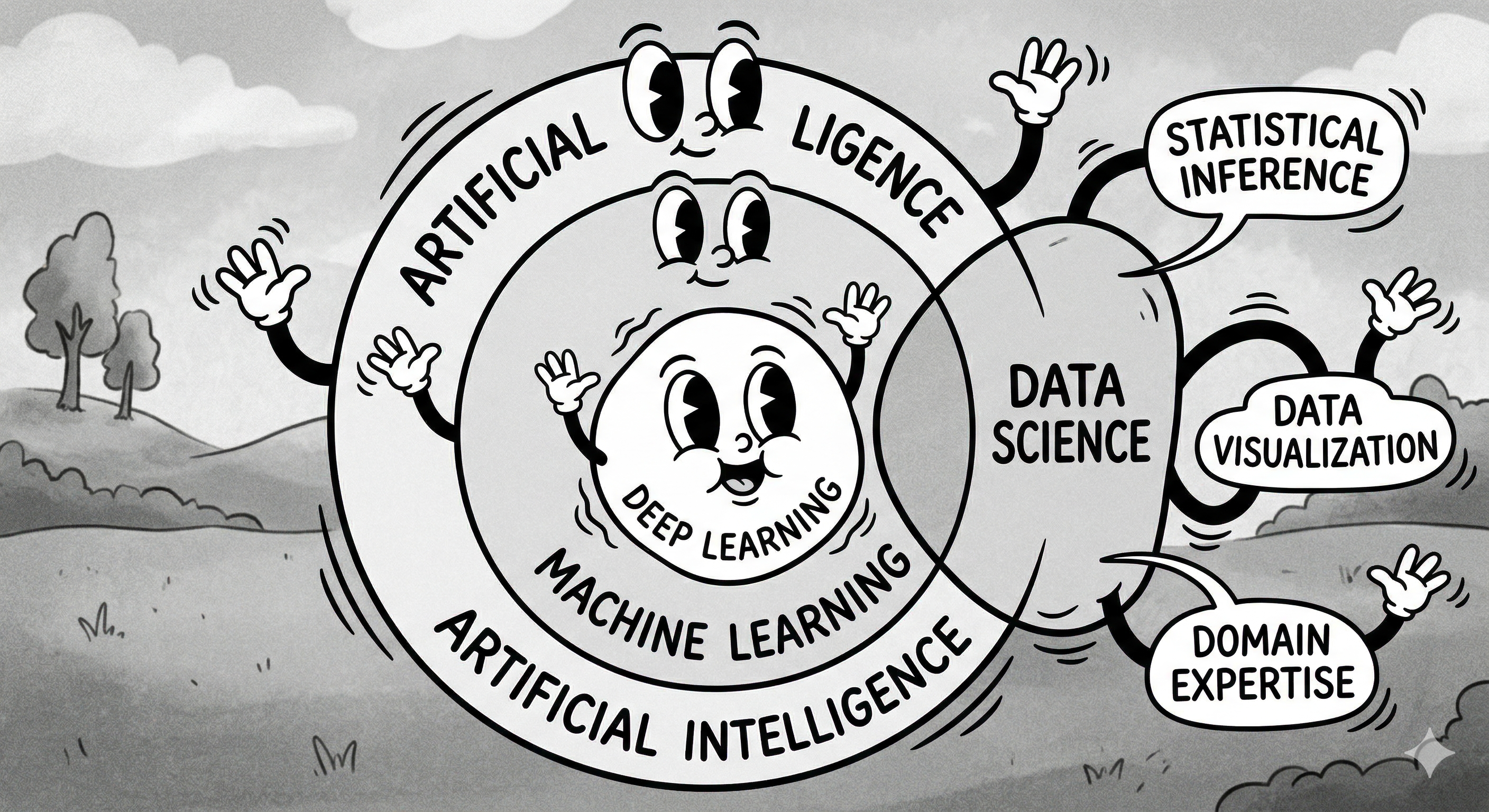
In contemporary discourse, the terms Artificial Intelligence, Machine Learning, Deep Learning, and Data Science are frequently conflated. However, achieving technical fluency requires a precise understanding of their distinct boundaries and relationships. The architecture of these disciplines is best conceptualized as a series of nested concentric circles, with Data Science operating as an intersecting discipline that spans across them while maintaining its own distinct analytical territory.
Artificial Intelligence
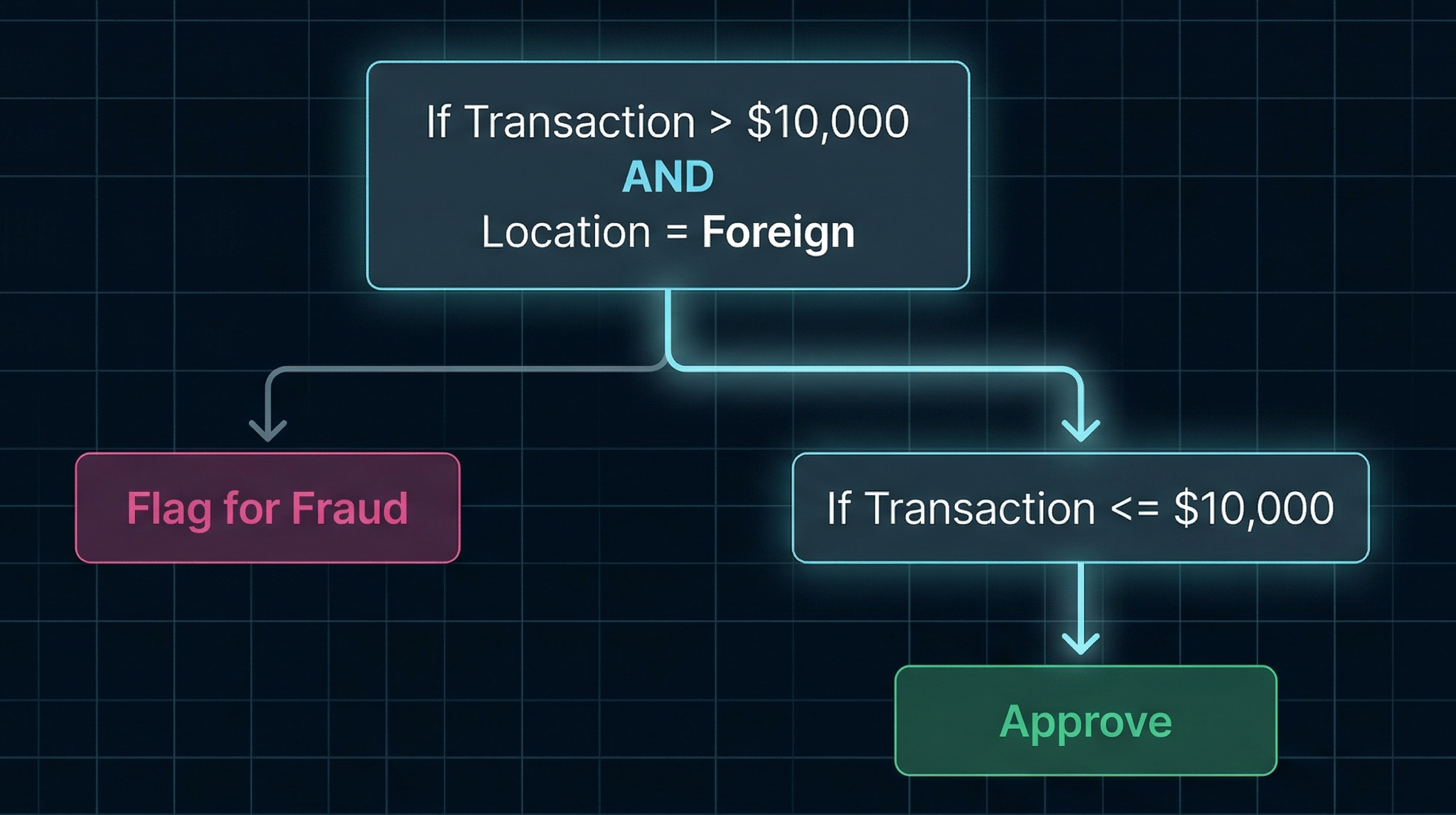 The story of Artificial Intelligence began in the mid-twentieth century with a bold dream: to breathe human-like understanding into cold, artificial devices. This immediately sparked a profound debate over what "intelligence" actually means. Some researchers envisioned machines that could perfectly mimic human behavior, a concept embodied by the famous Turing Test, where a computer attempts to seamlessly fool a human conversationalist. Others argued that true AI shouldn't just copy our flawed human minds, but rather embody pure, rational logic to always make the mathematically perfect decision. This philosophical divide birthed different technological ambitions, ranging from using computers to study our own cognitive processes, to the ultimate, still-unreached goal of "Strong AI" - a machine possessing genuine self-awareness and reasoning.
As scientists began building these systems, they uncovered a fascinating paradox about the nature of intelligence. Computers quickly mastered highly complex "expert" tasks, like diagnosing diseases, solving intricate calculus, or defeating chess grandmasters. Yet, those same brilliant machines completely failed at "common-place" tasks a toddler finds easy, such as walking across a messy room, interpreting a complex visual scene, or understanding conversational language. Because creating a true, human-equivalent mind proved overwhelmingly difficult, the industry successfully pivoted toward "Weak" or "Applied AI". Today, rather than building a single artificial brain, we rely on specialized, simulated intelligence that silently detects credit card fraud, powers autonomous robots, and translates languages, proving that even a narrow emulation of thought can fundamentally transform our world.
Machine Learning
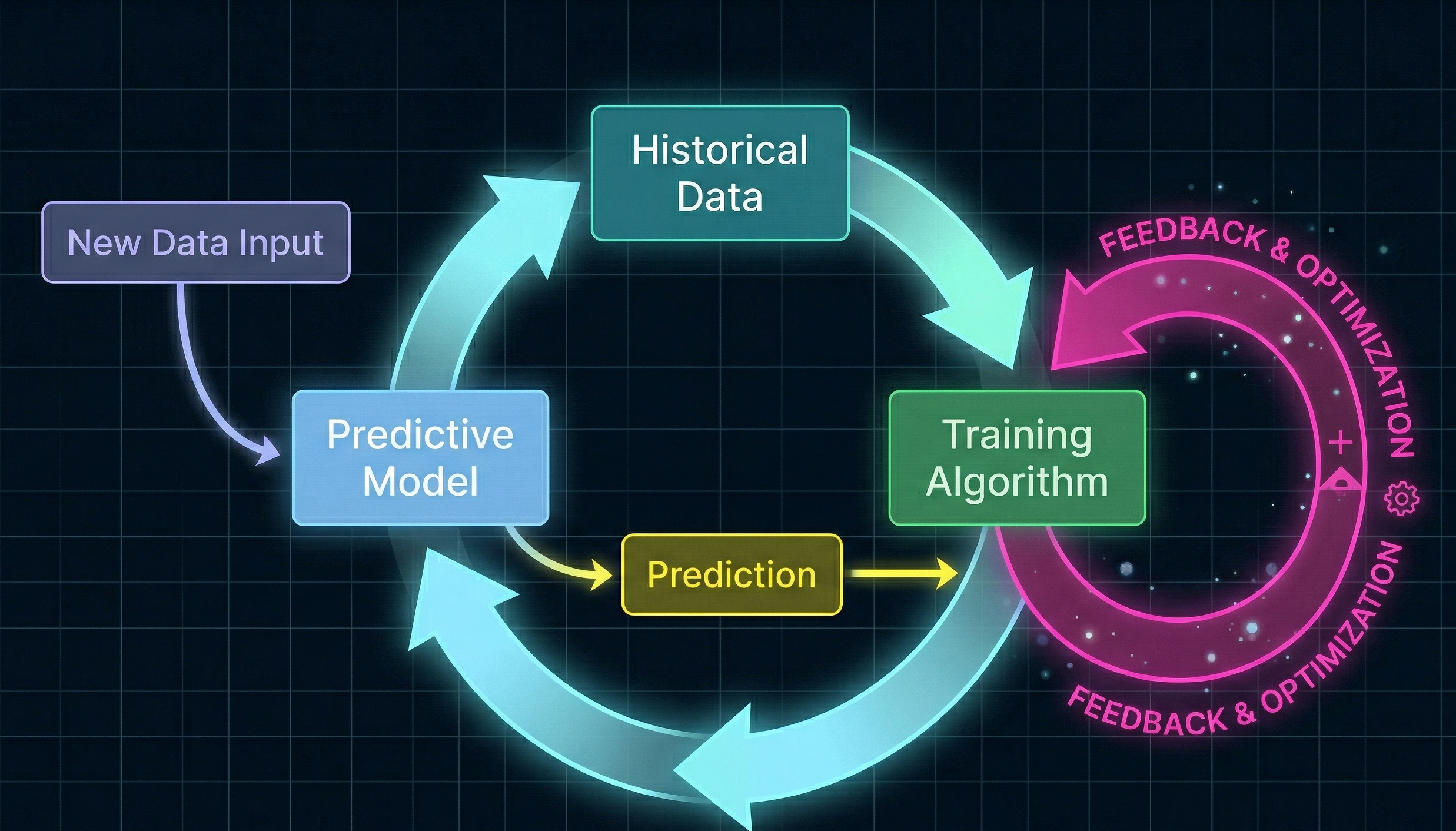 Machine Learning is a dynamic subfield of Artificial Intelligence focused on building systems that naturally adapt and improve through experience. In traditional AI, programmers had to manually write rigid rules to solve problems. However, in the real world, environments change rapidly, and writing explicit rules for complex, subjective tasks is often impossible. Machine learning solves this by using inductive reasoning: instead of relying on hard-coded instructions, the system analyzes vast amounts of data to independently discover the underlying rules and patterns on its own.
At its core, a machine learning system is defined by three main elements: the Task it needs to perform, the Experience it gathers, and the Performance measure used to evaluate it. For example, if the task is learning to drive an autonomous vehicle, the experience would be hours of recorded video and steering actions from human drivers. Its performance would be measured by how far it can drive without making an error. As the system gathers more experience, its internal mathematical algorithms automatically update to optimize its performance.
These systems can be designed to tackle several distinct types of problems. They can be used for prediction, such as forecasting future stock prices based on market trends. They excel at categorization, like a robotic vision system identifying whether a tool is a hammer or a wrench based on its shape. They can also perform clustering, which involves organizing messy, unlabelled data into distinct groups, such as segmenting satellite imagery into forests, cities, and lakes. Finally, they are used for planning, helping autonomous machines map out the most efficient and safe paths.
How a machine gathers its experience dictates its specific learning style. In supervised learning, the system acts like a student with an answer key; it learns from a "teacher" using data that already contains the correct outputs. Unsupervised learning lacks this teacher, forcing the system to explore raw data to uncover hidden structures entirely on its own. In active learning, the system can actually ask a human to clarify confusing data points. Meanwhile, reinforcement learning uses a system of trial and error, offering the machine mathematical rewards for correct actions and punishments for mistakes as it navigates an unknown environment.
Ultimately, true machine intelligence requires more than just memorizing past data. A successful model must be able to generalize from its training to make accurate predictions about brand new, unseen situations. To achieve this, the system relies on an "inductive bias"—a set of built-in logical assumptions that guides it to choose the most useful, overarching patterns rather than just memorizing exact historical events. To make this learning process efficient, raw, real-world data is broken down into clear, measurable "features" (like age, color, or dimension), giving the machine a structured way to perceive and master its environment.
Deep Learning
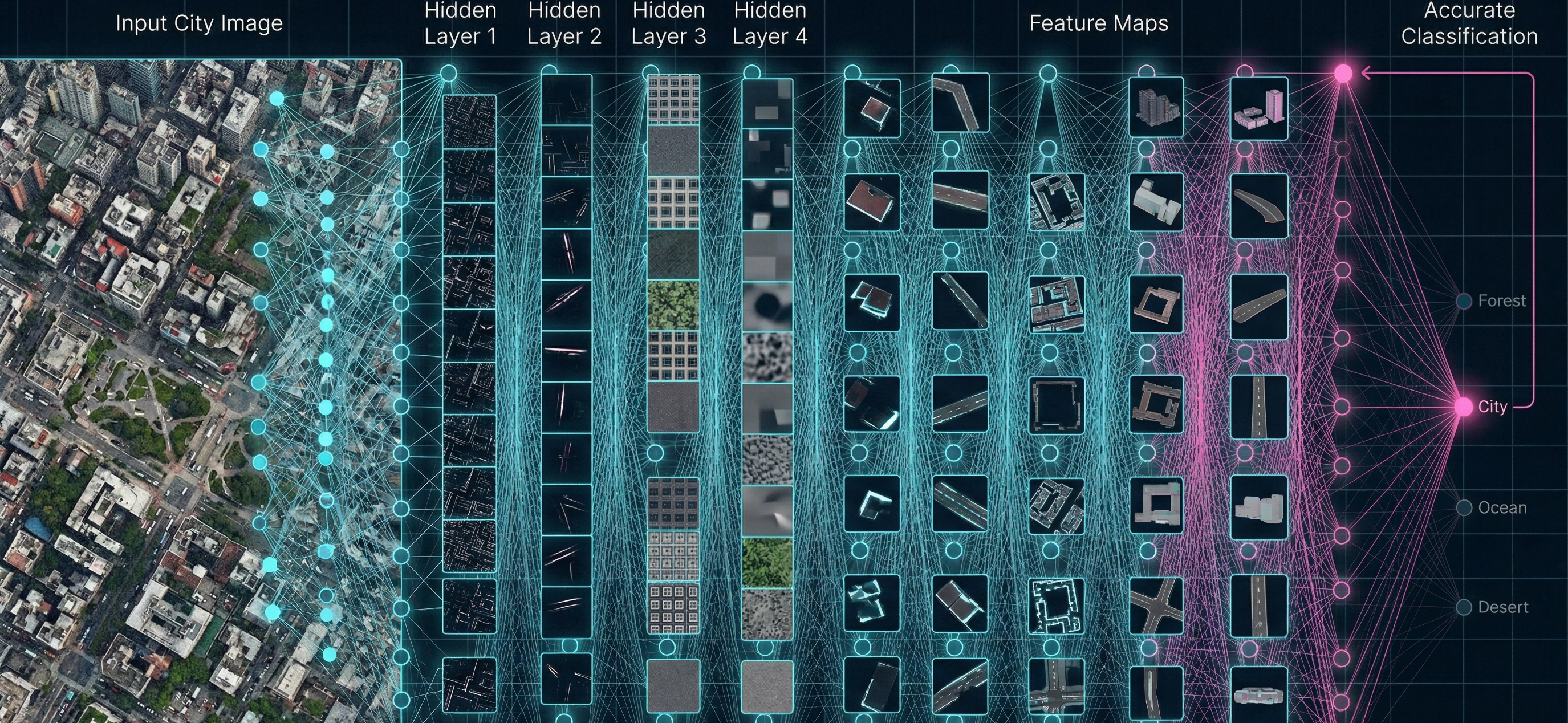 Deep Learning is a highly specialized and powerful subfield of machine learning that builds directly upon the foundational concepts of artificial neural networks. While traditional neural networks may utilize only one or two hidden layers to process information, deep learning algorithms are distinguished by their "depth"—employing massive architectures with dozens or even hundreds of interconnected hidden layers. This structural depth provides the versatility to model incredibly complex, non-linear relationships and allows the system to learn representations of data through multiple levels of mathematical abstraction.
Like its biological inspiration, deep learning relies on adjusting the connections (weights) between artificial neurons. However, it operates on a scale that fundamentally changes how machines handle information. Traditional machine learning often requires human engineers to manually extract and define the important features of a dataset before the computer can learn from it. Deep learning bypasses this bottleneck. By ingesting vast amounts of raw, unstructured data—such as high-resolution images, audio waveforms, or massive text corpuses—a deep neural network acts as an autonomous expert, discovering the underlying patterns and features entirely on its own.
Because of their remarkable capacity to process raw, complicated data environments, deep learning models are the driving force behind modern artificial intelligence breakthroughs. Their key advantages include:
- Automatic Feature Extraction: The network independently discovers and prioritizes the most relevant data features needed for a task, eliminating the costly and error-prone process of manual feature engineering by humans.
- Hierarchical Learning: The system builds knowledge sequentially. In a visual system, the first layer might only recognize simple dark and light edges. The next layer combines those edges into shapes, and the final layers combine those shapes to recognize a complex object, like a human face or a vehicle.
- Scalability with Big Data: Classical machine learning models eventually reach a performance plateau, where adding more data does not improve accuracy. Deep learning models, conversely, continue to improve and refine their predictive power as they are fed larger volumes of data and provided with more computational resources.
- Mastery of Unstructured Data: Deep networks natively excel at translating chaotic, unstructured inputs (like the pixels of a video or the chaotic frequencies of human speech) into precise, structured outputs.
Deep Learning Architectures
Deep learning is not a single algorithm, but rather a family of neural network architectures. These networks are differentiated by how their layers are mathematically structured and connected, with specific topologies designed for specific types of data. Some of the most prominent architectures include:
Convolutional Neural Networks (CNN): These networks are specifically engineered to process data with a known, grid-like topology, most notably digital images. Instead of looking at an image all at once, they use mathematical "convolution" operations to scan across small sections of the data, effectively preserving the spatial relationships between pixels. This architecture is the global standard for computer vision applications, such as autonomous driving, facial recognition, and automated medical image analysis.
Recurrent Neural Networks (RNN) and LSTMs: While standard networks process data in single, isolated passes, RNNs are constructed with internal memory loops. This allows previous information to persist and inform the current processing step, making them essential for sequential data where time and order matter. Long Short-Term Memory (LSTM) networks are an advanced variation that excel at remembering long-term dependencies, dominating temporal applications like speech recognition, time-series forecasting, and language translation.
Generative Adversarial Networks (GAN): This novel architecture involves two separate deep neural networks—a "generator" and a "discriminator"—competing against each other. The generator learns to create highly realistic synthetic data, while the discriminator acts as a detective trying to identify whether the data is real or fake. This continuous adversarial training results in models capable of generating photorealistic images, synthesizing highly accurate human voices, and creating advanced simulations.
Transformers: A revolutionary architecture that fundamentally changed Natural Language Processing. Instead of processing data sequentially like an RNN, Transformers process entire sequences simultaneously using "attention mechanisms." This allows the network to weigh the contextual importance of different words in a sentence, regardless of how far apart they are. Transformers are the underlying engine for modern Large Language Models (LLMs), enabling machines to understand deep linguistic nuances and generate human-like text with unprecedented fluency.
Data Science
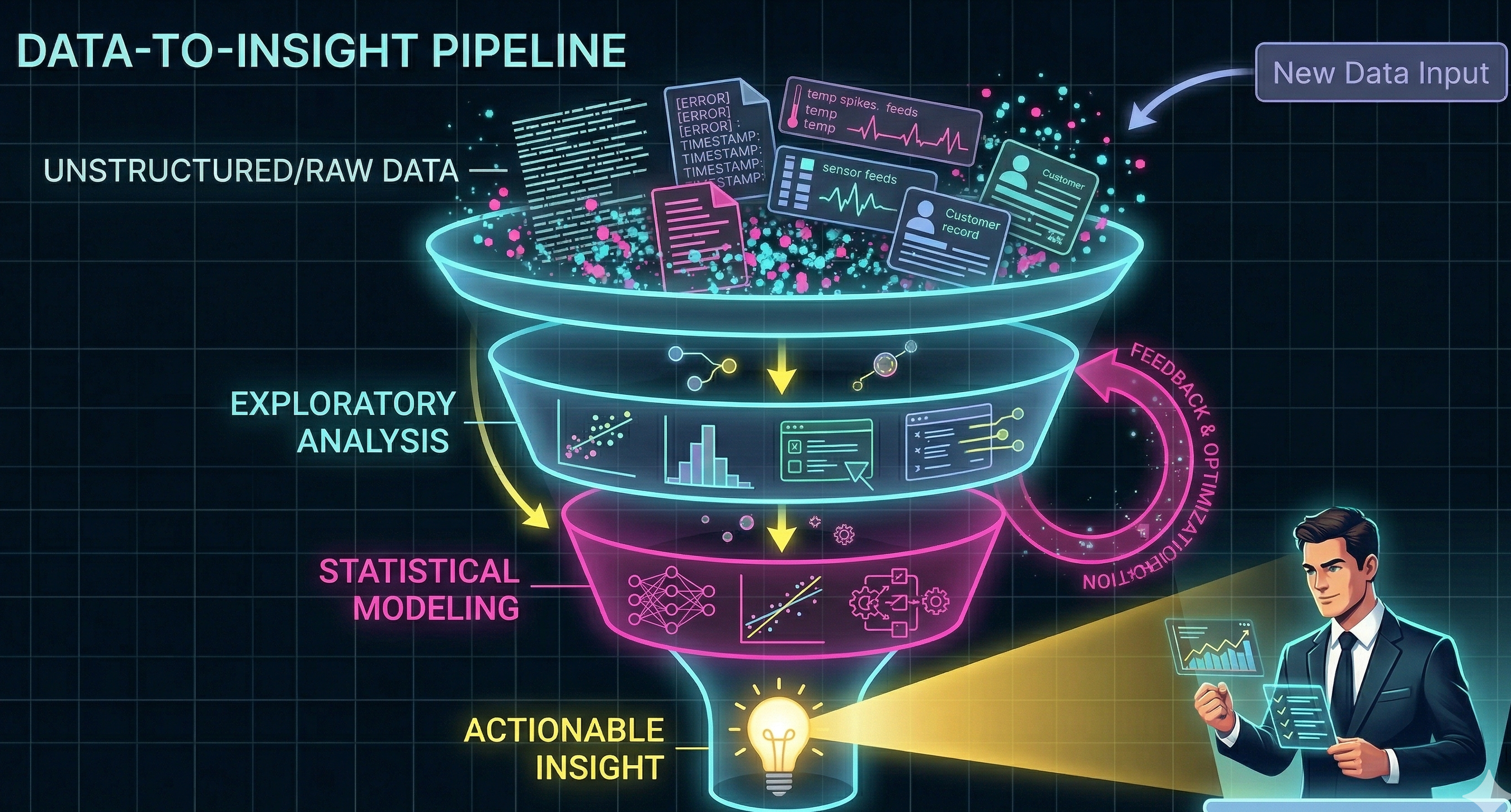 Data Science is fundamentally distinct from the pure engineering pursuits of artificial intelligence, operating instead as a multidisciplinary framework designed to extract actionable insights from vast, complex datasets. While an AI engineer builds autonomous systems to perform tasks, the data scientist acts as an analytical investigator seeking to solve specific, real-world business problems. This field represents the crucial intersection of advanced mathematics, traditional statistics, computer science, and deep domain expertise.
A practitioner begins by wrangling chaotic, raw information—often referred to as Big Data—cleaning and structuring it into a mathematically usable format. From there, they employ rigorous exploratory data analysis to uncover hidden trends, correlations, and anomalies that are invisible to the naked eye.
While data scientists frequently utilize machine learning algorithms as powerful predictive tools, their ultimate objective is rarely just the deployment of a software model; instead, the goal is profound comprehension. For instance, a global logistics company might employ data science to analyze millions of shipping routes, weather patterns, and fuel prices not just to build an automated routing system, but to understand the fundamental drivers of supply chain delays and optimize their international infrastructure. The data scientist then synthesizes these complex mathematical findings into intuitive visual dashboards and coherent strategic narratives. By bridging the gap between raw numbers and executive decision-making, data science transforms passive information into a vital corporate asset, enabling organizations to navigate uncertainty with mathematically grounded confidence.