Doctors, loan officers and mechanics often reason the same way: ask one question, then another depending on the answer, until the case is clear. Is the fever above 39 °C? If so, is there a rash? A decision tree learns such a sequence of questions from data. It is one of the few models whose entire logic can be printed on a page and read by a non-specialist, and it is the building block of the strongest classical methods, random forests and boosted trees.
What a tree is
A decision tree is a flowchart.
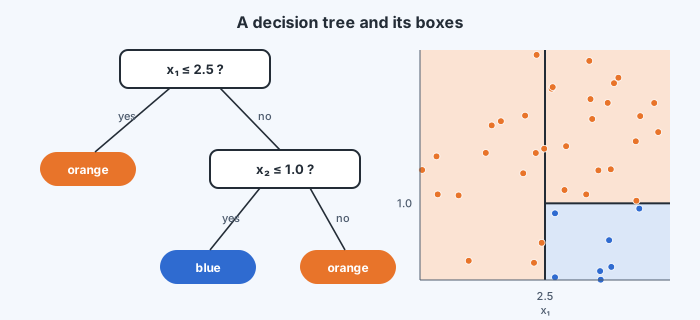
- Each internal node asks a question about a single feature, usually of the form is feature at most ?
- Each branch follows one answer.
- Each leaf gives a prediction: the majority label of the training points that end up there (or, for probabilities, their class proportions).
To classify a new point, start at the root and follow the answers to a leaf.
Geometrically, each question cuts the feature space with an axis-aligned line (a hyperplane perpendicular to one axis), and each leaf corresponds to a box. A tree of depth can produce up to boxes, which lets it approximate complicated boundaries with a staircase of rectangles.
Measuring how mixed a node is
A good question splits a mixed group of points into purer groups. To make "pure" precise, let be the fraction of class among the points at a node.
The entropy of the node's labels is
It is 0 when the node is pure ( or ) and largest, 1 bit, when the classes are evenly mixed (). It measures how uncertain we are about the label of a random point at the node.
A popular alternative is the Gini impurity, , with the same shape: 0 when pure, largest at . It is slightly cheaper to compute and usually picks very similar splits.
Choosing a question: information gain
Suppose a question splits a node's points into a left group of points and a right group of . The information gain is the drop in impurity, weighting each child by its share of the points:
To pick the question at a node, try every feature and every useful threshold (the midpoints between consecutive sorted values of that feature), and choose the one with the largest gain.
A worked example
A node holds 10 points: 6 positive, 4 negative. Its entropy is bits. Two candidate questions:
- Question A sends 5 points left (5 positive, 0 negative) and 5 right (1 positive, 4 negative). Left entropy 0; right . Weighted: . Gain .
- Question B sends 4 left (3 positive, 1 negative) and 6 right (3 positive, 3 negative). Entropies and . Weighted: . Gain .
Question A is far better: it produces a perfectly pure child. The tree takes A and repeats the procedure inside each child.
Growing the tree
The standard algorithm is greedy and recursive.
- At the root, choose the question with the highest gain.
- Split the data accordingly and repeat in each child.
- Stop at a node when it is pure, or a stopping rule fires: a maximum depth, a minimum number of points per leaf, or a minimum gain.
Greedy means each question is the best at that moment, not the best for the tree as a whole. Finding the globally optimal tree is NP-hard, and greedy growth works well in practice.
Overfitting and how to stop it
Let a tree grow until every leaf is pure and it will reach zero training error on almost any data set, by giving isolated noisy points their own tiny boxes. Such a tree has high variance: change a few training points and its structure changes completely. The remedies all limit complexity:
- Pre-pruning: cap the depth, require a minimum number of points per leaf, or require a minimum gain to split.
- Post-pruning: grow a large tree, then remove subtrees whose removal does not hurt (or barely hurts) validation error. Cost-complexity pruning does this with a penalty per leaf, chosen by cross-validation.
- Ensembles: average many trees, which is the subject of Module 11 and usually the most effective fix of all.
Strengths and weaknesses
Strengths: readable rules; no need to scale features (only their order matters); handles mixed numeric and categorical features; fast to predict; captures interactions between features naturally (a question on feature 2 asked only when feature 1 is large).
Weaknesses: axis-aligned staircases approximate diagonal boundaries poorly; a single tree is unstable; and greedy growth can miss splits that only pay off two levels down (the classic example is XOR, where no single first split has any gain).